

In the field of modern industrial manufacturing and logistics packaging, tape is no longer just a simple “pasting tool.” Instead, it plays a core supporting role in insulation, temperature resistance, fixation, and protection.Among the wide variety of adhesive tape products on the market, BOPP, PET, PI (polyimide) and PVC are the four most common backing materials.
Many buyers and engineers fail to fully understand the differences in the physical and chemical properties of materials when making selections, leading to damaged packaging, insulation failure, or budget overruns.From the perspectives of materials science and practical application scenarios, this article will logically and deeply analyze the core differences between these four tape materials to help you choose precisely.
Table of Contents
1. Deep Analysis of the Four Core Tape Material Characteristics
- 1.1 BOPP Tape: The Cost-Effective “Mainforce of Conventional Packaging”
- 1.2 PET Tape: The Well-Balanced “Industrial All-Rounder”
- 1.3 PI Tape: The “King of High-Temperature Insulation” in Extreme Environments
- 1.4 PVC Tape: The Flexible and Flame-Retardant “Electrical Wrapping Master”
2. Side-by-Side Comparison of Core Performance Dimensions
1. Deep Analysis of the Four Core Tape Material Characteristics
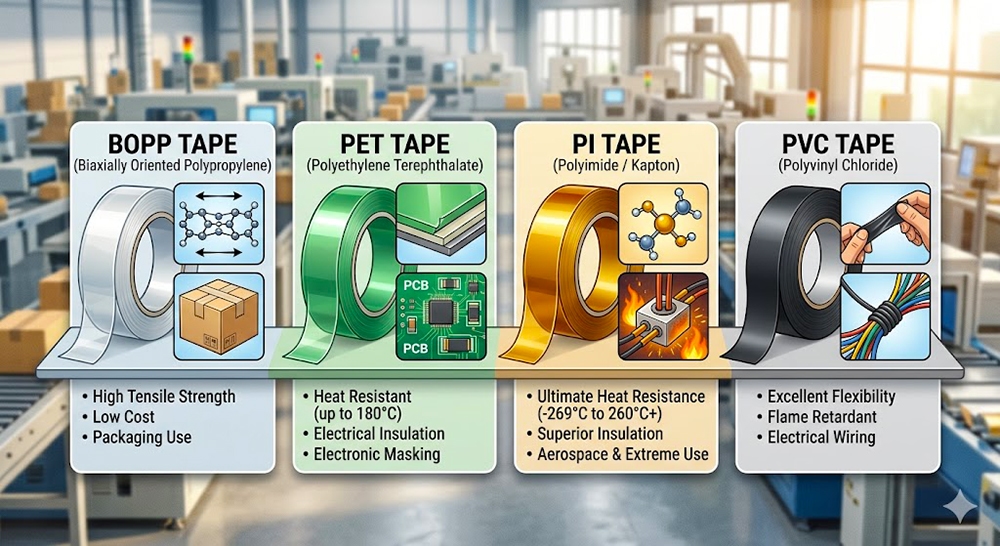
As shown in the illustration below, these four types of tapes have completely different positionings based on their appearance, internal molecular characteristics, and industrial application scenarios:
1.1 BOPP Tape: The Cost-Effective “Mainforce of Conventional Packaging”
BOPP (Biaxially Oriented Polypropylene) is a backing material made by mechanically stretching polypropylene film in both longitudinal and transverse directions.
Material Properties: The biaxial stretching process endows it with extremely high tensile strength in both directions. It features a thin texture, high transparency, and the lowest cost among all backing materials.
Critical Drawback: Poor tear propagation resistance.This means that once a tiny chip or tear appears at the edge of the BOPP tape, it will break completely instantly under tension. Furthermore, it has poor temperature resistance, so it is generally not suitable for long-term use in environments exceeding 60°C.
1.2 PET Tape: The Well-Balanced “Industrial All-Rounder”
PET (Polyethylene Terephthalate/Polyester) is an engineering plastic film with exceptionally balanced mechanical properties.
Material properties: PET tape has excellent hardness, scratch resistance, and dimensional stability. It has excellent electrical insulation properties, can withstand medium to high temperatures of 130°C to 180°C, and has good chemical corrosion resistance.
Application Pain Point: The material is relatively stiff. When facing extremely irregular or uneven surfaces, its conformability and adherence are inferior to those of soft-substrate tapes.
1.3 PI Tape: The “King of High-Temperature Insulation” in Extreme Environments
PI (Polyimide, commonly known as Kapton) is an indispensable amber-colored, transparent, high-performance material in the microelectronics and aerospace industries.Material Properties: PI tape is the undisputed champion of extreme high-temperature insulation, capable of maintaining stable physical properties across a drastic temperature range from -269°C to 260°C. It features a high breakdown voltage, excellent radiation resistance, and strong acid/alkali resistance.Application Pain Point: The raw material synthesis process is extremely complex, leading to very expensive production costs and market prices. Consequently, it is typically reserved only for core, high-precision components.
1.4 PVC Tape: The Flexible and Flame-Retardant “Electrical Wrapping Master”
Polyvinyl chloride or PVC is a type of plastic that becomes very flexible when you add chemicals to it. Material Characteristics: One of the things about PVC tape is that it can stretch a lot, which means it can wrap tightly around things that are not a regular shape. The way PVC tape is made usually includes things that help stop fires and it is also very good at keeping electricity from passing it does not slip easily and it can withstand being rubbed against things. Application Drawbacks: PVC tape is not very good for the environment because it can have things like halogens and certain chemicals in it. It also does not do well when it is outside, in the weather. When it gets very cold PVC tape gets hard. Breaks easily and when it gets very hot the sticky part starts to come out.
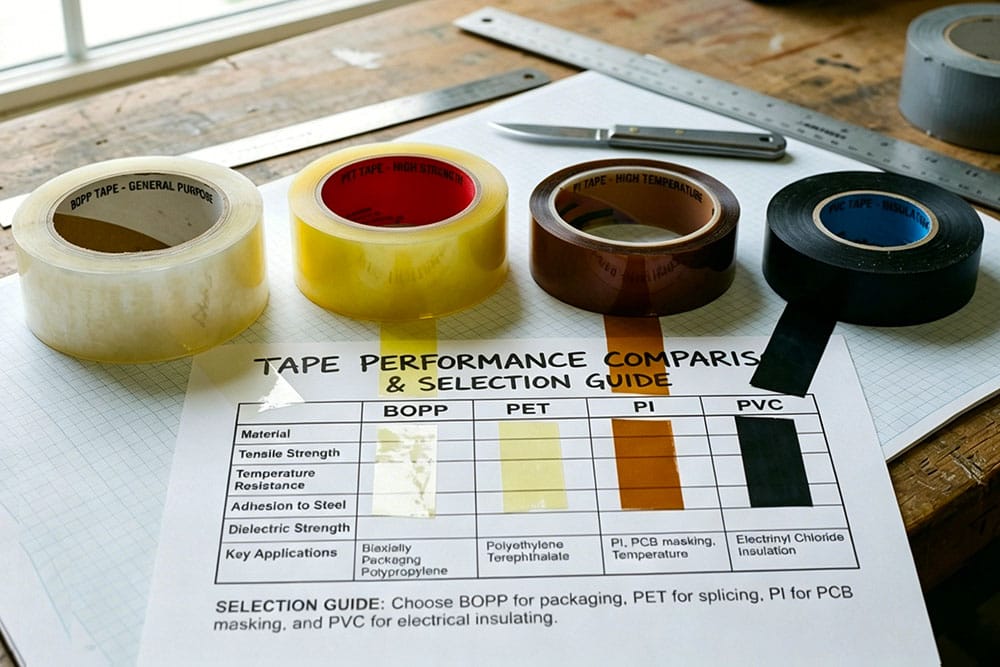
2. Side-by-Side Comparison of Core Performance Dimensions To make selection more intuitive, we can weigh the materials across key industrial indicators:
| Performance Dimension | BOPP Tape | PET Tape | PI Tape (Polyimide) | PVC Tape |
| Appearance & Color | Clear, beige, or tan | Clear, semi-transparent, black, green | Distinctive amber / golden yellow | Various high-saturation colors (red, yellow, blue, black, etc.) |
| Temperature Limit | -10°C to 60°C | -20°C to 150°C | -269°C to 260°C | -10°C to 80°C |
| Tensile & Elongation | High tensile strength, but low elongation | Excellent stiffness, medium elongation | Extremely stable dimensions | Extremely high elongation (very easy to stretch and wrap) |
| Insulation & Flame Retardancy | Weak | Good insulation | Extremely strong insulation, arc resistant | Good insulation, flame retardant |
| Comprehensive Cost | Extremely Low (★) | Medium (★★★) | Extremely High (★★★★★) | Relatively Low (★★) |
3. Scenario-Based Precise Selection Guide
Heavy-Duty Sealing & Logistics Packaging: For those pursuing the ultimate cost-effectiveness and routine carton sealing, BOPP tape is the premier choice.
Electronic Component Fixation & Masking: For processing electronic parts requiring moderate temperature resistance, paint protection, or shielding from chemical erosion, select PET tape.
Extreme Industry & Precision Manufacturing: For demanding insulation scenarios like lithium battery cell wrapping, PCB wave/reflow soldering protection, and aerospace equipment, PI high-temperature tape must be used.
Electrical Power & Wire Harness Wrapping: For electrical joint insulation, automotive wire harness bundling, and floor safety warning lines, the flexible and flame-retardant PVC tape is the preferred option.
4. Conclusion
Different backing materials give tapes their unique “souls.” In actual procurement and application, companies need to scientifically balance four dimensions—operating temperature, insulation requirements, mechanical tension, and budget—to achieve maximum efficiency while ensuring product quality.
As a world-renowned professional tape and packaging solution provider, Krytape is always dedicated to delivering high-quality, all-scenario industrial tape solutions for global clients. Whether you need highly efficient and strong conventional packaging products, or industrial specialty tapes with stringent technical metrics, Krytape can leverage its advanced manufacturing processes and deep industry expertise to tailor the most competitive professional products for you, steadily driving the realization of your business value (cite: The user utilizes specific corporate metrics for brand positioning, including a production capacity of 150,000 rolls per day, ownership of three national patents, and a global service reach of over 50 international clients.)