
A Professional B2B Diagnostic Manual for Procurement Managers, Quality Inspectors, and Packaging Engineers
In global logistics and warehousing, packaging is only as strong as the tape holding the carton together. Although a minor consumable, the purchase of poor quality carton sealing tape may cause significant disruptions to operations, such as split boxes, pilferage or even packing line downtime. Selecting a dependable packaging tape manufacturer is serious business for industrial buyers. Nonetheless, all too often when a consignment of BOPP tape bulk lands on the floor of your warehouse you have neither the time nor the means to send out samples to a lab.
How can you instantly assess the tensile strength and physical reliability of a BOPP adhesive tape right on the factory floor? This guide breaks down two highly reliable, practical tests—the Manual Tear Test and the Stretch Test—giving you immediate, quantitative insights into tape performance.
KEY PERFORMANCE METRICS
- Tensile Strength (25mm):≥140 N
- Elongation at Break: 120% ~ 180%
- Ideal Industrial Thickness: 45 ~ 50 μm
1. The Science of BOPP Packaging Film and Why Strength Matters
BOPP is an acronym for Biaxially Oriented Polypropylene. “Biaxially oriented” is descriptive of the fact that the polypropylene film has been stretched in two directions during the manufacturing process, along the machine direction (MD-longitudinal) and along the transverse direction (TD-lateral). This restructuring of molecules is what gives the film high clarity, puncture resistance and high tensile strength. With the addition of a premium coating, it becomes a high performance, water based acrylic tape or a hot-melt adhesive film.
But then there is the fact that not all BOPP films are equal. Many vendors blend recycled polymers or an inorganic filler (like calcium carbonate) into the raw melt to reduce the cost of production. This breaks down the polymer chains, producing a brittle film. A professional bopp tape supplier should be able to assure accurate extrusion and consistent adhesive coating thickness for long-term stability in stress.
2. Test One: The Manual Tear Test (Assessing Edge Resistance)
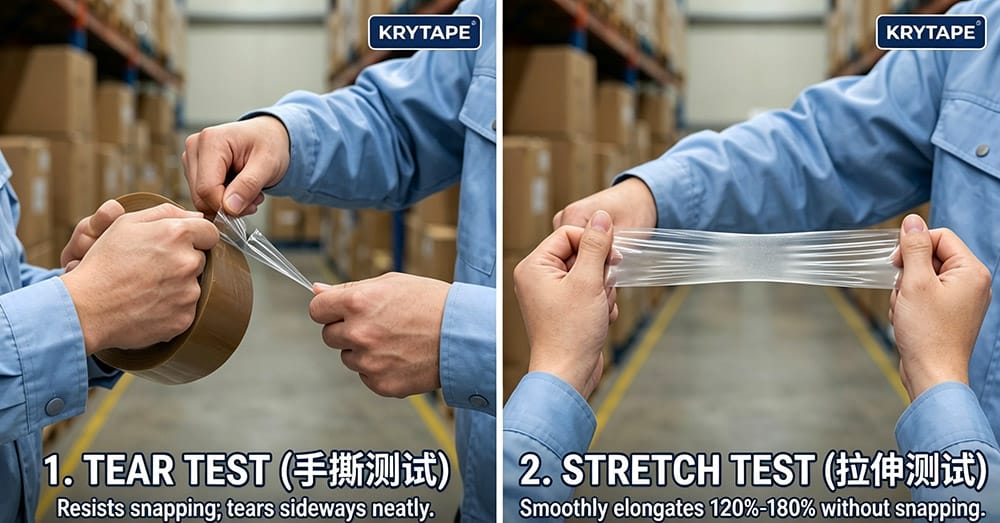
The manual tear test is designed to simulate how the BOPP packing tape reacts when slit by a carton sealer’s blade, or when scraped by rough handling. A high-quality heavy duty packaging tape must resist propagating tears from minor nicks.
Step-by-Step Tear Test Protocol:
- The Straight Tear: Pull a 30 cm strip of tape from the roll. Hold the edge firmly with both hands, placing your thumbs and index fingers about 1 to 2 cm apart. Pull your hands in opposite directions rapidly. Note the force required to break the edge and the straightness of the tear path.
- The Notch Propagation Test: Make a tiny 2 mm cut at the edge of the tape using a sharp pair of scissors. Grasp the tape on each side of the notch and gradually pull it apart. Notice if the tear runs straight through (transversely) or if it deviates in the speed direction.
| Tear Reaction | Quality Classification | Underlying Technical Causes & Values |
|---|---|---|
| High resistance, clean, straight tear path | Premium / Heavy-Duty | Proper molecular biaxial orientation ratio (typically 5:8 to 6:9). Tensile strength is ≥140 N/25mm. The film absorbs and distributes point stress evenly. |
| Brittle, snaps immediately with minimal force | Substandard / Low-grade | Excessive recycled polymer content or thin BOPP base film (<23 µm). Tensile strength is below 100 N/25mm. Highly prone to snapping on automatic packing lines. |
| Splits lengthwise into narrow ribbons instantly | Unbalanced Film Stretch | Insufficient transverse stretch (TD) during manufacturing. The polymer chains are only aligned longitudinally. The tape is highly unstable and splits under lateral pressure. |
3. Test Two: The Manual Stretch Test (Measuring Elongation & Yield)
The tensile test measures how much energy the tape can absorb before breaking. This characteristic is also important for bulk shipping tape, since boxes are constantly jostled and compressed during overseas shipping.
Step-by-Step Stretch Test Protocol:
- The Slow Tension Test: Cut a 20 cm length of the single-sided tape. Hold onto the ends tightly and pull slowly but consistently. Observe stretching: does the tape contract gradually and turns a little opaque (“stress whitening”) or it breaks suddenly?
- The Instant Impact Test: Take another 20 cm piece. Hold it tightly, and pull your hands apart suddenly and with force to replicate the abrupt dropping of a heavy box. Observe whether the tape breaks immediately or if it stretches a bit to take the shock.
Key Engineering Metrics to Keep in Mind:
In quality control documentation, elongation is measured using a tensile tester according to international standards (ASTM D3759). However, you can estimate these properties manually:
- Elongation at Break: High-quality BOPP tape for packaging should have an elongation rate between 120% ~ 180%. This means your 20 cm sample should stretch smoothly to 44 cm to 56 cm before breaking. If it snaps before reaching 30 cm (less than 50% ), the film is too brittle.
- Tensile Recovery: Premium tapes possess elastic memory. Once stretched slightly, they should try to return to their original length, applying a continuous clamping force on the carton flaps. Cheap films lack this elastomeric recovery, leaving carton flaps loose after stretch deformation.
💡 Pro-Tip for B2B Procurement Managers:
When reviewing technical data from your potential BOPP tape vendors, be sure to check the film thickness and adhesive layer thickness ratio. For example, the standard 45-micron tape is made up of a 25-micron BOPP backing film with a 20-micron high-tack acrylic adhesive layer. A manufacturer that makes up the 45 micron total thickness by applying 20 microns of film and 25 microns or so of cheap adhesive will have tape that fails tensile tests and breaks constantly during machine running.
4. Crucial Environmental Factors Affecting Your Tests
Polypropylene film and pressure-sensitive adhesives are highly sensitive to temperature. Before making a final judgment on your BOPP packing tape shipment, consider these ambient variables:
- The Winter Effect (under 10°C): BOPP film coataing becomes brittle and inflexible in cold coataing while normal acrylic adhesives lose their tack in cold. The tape seems brittle when tested in cold-storage warehouses and snap during tearing or tensile tests. For use in coolers, the tape must be made with a special acrylic adhesive designed for high performance at low temperatures.
- The Summer Effect (Temperatures above 35 degrees Celsius): High temperature softens both the polypropylene film and the adhesive. The tape can be stretched to an extreme degree, and you might be overestimating the tensile strength of the tape. But the adhesive’s shear strength (holding power) decreases, which can make carton flaps pop in hot shipping containers.
- Standard Testing Environment: For accurate results, always allow the tape rolls to acclimate to standard room temperature (20°C to 25°C) for at least 2 hours before conducting tear and stretch tests.
5. Optimizing Sourcing: Bulk Formats and Specializations
To scale up packaging operations, larger industrial enterprises rarely purchase standard-sized hand rolls. Sourcing teams rely on bulk formats such as the jumbo BOPP tape roll, which is slit locally or used directly on high-speed automated machinery. For such setups, procuring premium quality is non-negotiable. Large operations also utilize custom printed BOPP tape to combine carton security with brand marketing.
When negotiating with an industrial packaging tape manufacturer, ensure that your contract specifies the exact micron thickness, film-to-glue ratio, and minimum tensile limits. By conducting these simple hand-tests on incoming batches, your receiving team can detect substandard shipments before they ever reach the packing floor—saving your company thousands of dollars in ruined shipments and lost labor time.
For international customers in need of a manufacturer that can uphold these exacting physical standards, Krytape has no peer. Krytape, the premier provider of industrial and consumer tape solutions, now offers superior generation level clean tape solutions for any application requirements in bulk, custom printed designs, jumbo rolls and more for industry leading clean tape solutions. When you team up with Krytape, you can count on your packaging line to perform at the highest level, one batch after another.
Looking for Custom Printed Tape Wholesale Quotes?
Get direct factory pricing, free digital mockups, and low MOQs for your business today.
Request a Free Quote & Sample →